EJATSM Acreditation Certificate 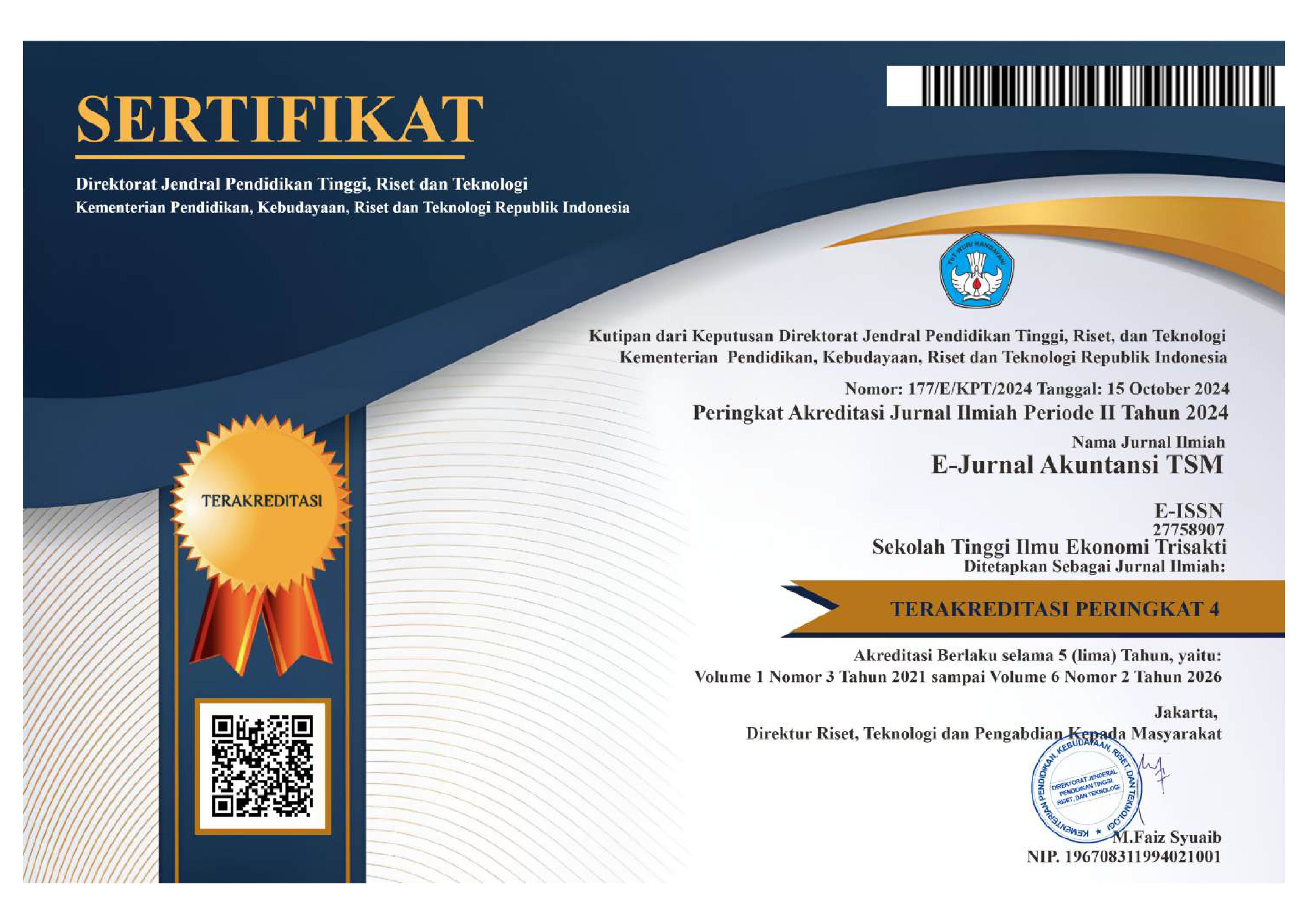
Post Publication Policy
E-Jurnal Akuntansi TSM
1. Policy Statement
E-Jurnal Akuntansi TSM is committed to transparency, academic integrity, and constructive scholarly communication at every stage of publication, including after an article has appeared.
The journal views scholarly evaluation as something that continues beyond publication. Post-publication discussion gives researchers, academics, practitioners, and readers a chance to examine published findings critically, exchange perspectives, point out possible errors, and add to the growth of knowledge.
The journal welcomes evidence-based discussion of its published articles, in line with the principles of responsible scholarly publishing and the relevant guidelines of the Committee on Publication Ethics (COPE). All such discussion must remain professional, objective, and honest, and must show respect for authors and other contributors.
2. Scope of Post-Publication Discussion
The journal welcomes constructive academic discussion of articles it has published. Topics may include:
- research methodology, theoretical frameworks, and conceptual approaches;
- data collection, statistical analysis, and the interpretation of findings;
- limitations, implications, and possible contributions to the literature;
- inconsistencies, errors, or methodological weaknesses that could affect the reliability of published findings;
- possible ethical concerns about research conduct or publication practices;
- other scholarly matters relevant to accounting and the related disciplines the journal covers.
The journal does not accept comments that contain personal attacks, defamatory statements, discriminatory language, unsupported allegations, commercial promotion, or material unrelated to scholarly evaluation.
3. Submission of Post-Publication Comments
Authors, readers, researchers, reviewers, and other interested parties may send comments, questions, or concerns about a published article to the editorial office. A submission should include:
- the title, author(s), year of publication, and DOI or URL of the article concerned, where available;
- a clear description of the issue, question, or concern;
- the relevant scholarly arguments, supporting evidence, references, or documents;
- the contributor's name, institutional affiliation, and contact details.
Comments should concentrate on the scholarly content of the article and be presented in a clear, objective, evidence-based, and professional way. Submissions should be sent using the editorial contact details published on the journal's website.
4. Editorial Assessment and Moderation
The Editorial Board evaluates post-publication comments and decides whether they call for further editorial attention. On receiving a submission, the editorial team checks its relevance, scholarly soundness, supporting evidence, and consistency with the journal's publication ethics and editorial standards. It may ask for clarification, supporting documents, or expert opinions when needed.
Comments that contain unsupported accusations, inappropriate language, irrelevant material, or breaches of publication ethics may be declined. The Editor-in-Chief has final authority over how formal post-publication discussions are handled and whether they are published.
5. Authors' Right to Respond
Authors have the right to respond to substantive academic comments or concerns about their published work. When a discussion raises relevant scholarly questions or possible concerns about an article, the editorial team may contact the corresponding author and invite a response.
Authors are expected to give clear, evidence-based explanations backed by suitable references, data, or other documentation. The journal encourages constructive dialogue between authors and readers to clarify findings, clear up misunderstandings, and improve how published research is interpreted. All responses must meet professional standards and follow the journal's ethical guidelines.
6. Publication of Post-Publication Discussions
When a discussion makes a meaningful scholarly contribution, the journal may publish it in the form of comments, author responses, editorial notes, or other suitable communications. The editorial team chooses the format and mechanism according to the nature and importance of the discussion.
Where appropriate, a published discussion should clearly identify the original article and link or refer directly to it. The journal may put formal comments or responses through editorial assessment or independent peer review when necessary. Publication always remains subject to the approval of the Editor-in-Chief and the journal's editorial standards.
7. Corrections, Expressions of Concern, and Retractions
If a discussion reveals substantial errors, inaccuracies, or possible ethical violations, the journal will weigh the available evidence and decide on the appropriate editorial action. Depending on the nature and seriousness of the issue, it may take one or more of the following steps:
- A formal correction may be issued when an error affects part of an article without undermining its main findings or conclusions.
- Expression of Concern. An editorial notice may be published when there are serious concerns about the reliability or integrity of an article and the evidence is inconclusive or an investigation is still ongoing.
- An article may be retracted when substantial errors, unreliable findings, or research misconduct seriously damage the validity or integrity of the publication.
All corrective actions follow the journal's Correction and Retraction Policy, its Publication Ethics Policy, and relevant COPE guidance. Where applicable, the journal keeps clear links between the original article and any later correction, Expression of Concern, or retraction notice, so that the scholarly record stays transparent.
8. Ethical Standards and Confidentiality
Everyone taking part in post-publication discussion must act with academic honesty, fairness, confidentiality, and professional conduct. People who submit comments or concerns must disclose any conflict of interest that could influence their assessment of the published work.
The journal handles sensitive information, confidential research materials, and allegations of misconduct responsibly. It may protect the identity of people who report ethical concerns when confidentiality is justified and consistent with its procedures. Intimidation, harassment, retaliation, or other unethical conduct directed at people who raise legitimate concerns in good faith will not be tolerated.
9. Editorial Decisions and Appeals
The Editor-in-Chief and the Editorial Board decide how to respond to post-publication discussions. They consider the scholarly relevance of the concerns, the quality of the supporting evidence, the author's response, and the possible implications for the integrity of the article.
Anyone who disagrees with an editorial decision may send a reasoned appeal to the editorial office, together with relevant supporting evidence. The journal reviews appeals fairly and may consult independent experts when needed to avoid conflicts of interest and ensure an objective assessment.
10. Commitment to Scholarly Transparency
The journal regards post-publication discussion as an important part of responsible scholarly communication and ongoing scientific evaluation. Through constructive dialogue, transparent editorial procedures, and appropriate corrective action, it aims to strengthen the reliability, credibility, and scholarly value of what it publishes.
Authors, researchers, practitioners, and readers are encouraged to take part responsibly in discussions that help advance knowledge in accounting and related disciplines.
Editorial Contact
E-Jurnal Akuntansi TSM
Sekolah Tinggi Ilmu Ekonomi Trisakti
Jakarta, Indonesia
Website: https://jurnaltsm.id/index.php/EJATSM
Email: ejatsm@tsm.ac.id