JBA Acreditation Certificate 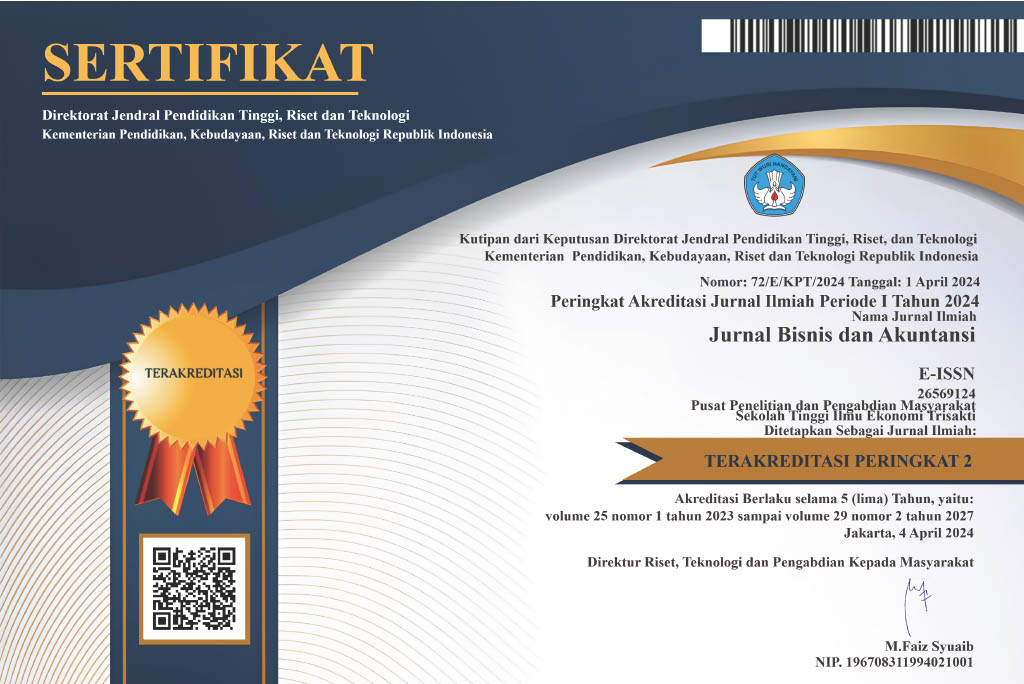
Allegation of Research Misconduct
Conflict of Interest Policy
Jurnal Bisnis dan Akuntansi (JBA)
1. Policy Statement
Jurnal Bisnis dan Akuntansi (JBA), published by Sekolah Tinggi Ilmu Ekonomi Trisakti, is committed to maintaining the integrity, objectivity, independence, and transparency of its scholarly publishing process.
A conflict of interest occurs when financial, professional, personal, institutional, or other relationships could influence, or reasonably be perceived to influence, an individual's judgment, decisions, or actions in the research, peer-review, editorial, or publication process.
JBA recognizes that the existence of a conflict of interest does not necessarily indicate misconduct. However, undisclosed or inadequately managed conflicts may compromise the credibility of research findings and the fairness of editorial decisions.
Accordingly, JBA requires authors, editors, reviewers, and other relevant parties to disclose potential conflicts of interest and cooperate in managing them appropriately.
This policy is informed by the principles of responsible scholarly publishing and relevant recommendations of the Committee on Publication Ethics (COPE).
2. Types of Conflicts of Interest
Conflicts of interest may arise in various forms, including but not limited to the following.
2.1. Financial Conflicts of Interest
Financial conflicts may include:
-
Employment, consultancy, or other paid relationships with an organization that may benefit from the research.
-
Research funding, grants, honoraria, or financial support from interested parties.
-
Ownership of shares, equity, or other financial interests in relevant organizations.
-
Patents, royalties, licensing arrangements, or other financial benefits related to the research.
-
Other financial relationships that could influence the interpretation, reporting, or publication of research findings.
2.2. Personal and Professional Conflicts of Interest
Personal or professional conflicts may include:
-
Family relationships, close personal relationships, or personal disputes.
-
Current or recent supervisory, mentoring, or collaborative relationships.
-
Professional competition, rivalry, or disputes that could affect impartial judgment.
-
Other personal or professional relationships that may reasonably be perceived as influencing an individual's decisions.
2.3. Institutional and Academic Conflicts of Interest
Institutional or academic conflicts may arise when an individual has an affiliation, responsibility, or interest that could affect their impartiality.
Examples include:
-
Institutional interests in the outcomes or publication of a study.
-
Relationships between authors and institutions responsible for funding, supervising, or evaluating the research.
-
Editorial or review responsibilities involving colleagues from the same institution where impartiality may reasonably be questioned.
-
Academic or professional interests that could influence the assessment of competing research or scholarly claims.
2.4. Other Relevant Interests
JBA also recognizes that non-financial interests, including personal beliefs, professional commitments, advocacy activities, and other affiliations, may create potential conflicts in certain circumstances.
All relevant interests should be disclosed when they could reasonably be perceived as affecting the objectivity or credibility of the research or publication process.
3. Responsibilities of Authors
All authors submitting manuscripts to JBA must disclose any actual, potential, or perceived conflicts of interest that are relevant to their research.
Authors should provide a conflict of interest declaration during manuscript submission and include an appropriate statement in the manuscript, even when no conflicts exist.
Authors are responsible for ensuring that disclosures are accurate, complete, and updated when necessary.
A conflict of interest declaration may include:
-
Financial support or funding relevant to the research.
-
Employment, consultancy, or other professional relationships with interested organizations.
-
Financial interests, ownership, patents, or commercial relationships related to the subject of the manuscript.
-
Personal, academic, or institutional relationships that could reasonably influence the research or its interpretation.
-
Any other interest that readers may reasonably consider relevant when evaluating the research findings.
When no conflicts of interest exist, authors should include the following statement:
"The authors declare that they have no conflicts of interest relevant to the publication of this article."
If a conflict exists, authors must describe the nature of the interest and its relationship to the research.
Funding information should also be disclosed in the appropriate funding statement or acknowledgment section.
Failure to disclose a relevant conflict of interest may result in editorial action in accordance with JBA's publication ethics policies.
4. Responsibilities of Editors
Editors must make editorial decisions based on the scholarly quality, originality, methodological rigor, relevance, and contribution of submitted manuscripts.
Editors must disclose any actual, potential, or perceived conflicts of interest that could compromise their impartiality.
An editor should not handle a manuscript when a conflict exists that may reasonably affect the fairness or independence of the editorial process. Examples include manuscripts authored by the editor, close collaborators, family members, or individuals with whom the editor has a relationship that could compromise impartiality.
When a conflict is identified, the manuscript should be assigned to another qualified editor who can manage the evaluation independently.
Editors must not use unpublished information obtained through editorial duties for personal, professional, or financial advantage.
All editorial decisions must be made fairly and confidentially, without inappropriate influence from authors, institutions, sponsors, or other interested parties.
5. Responsibilities of Reviewers
Reviewers must evaluate manuscripts objectively, independently, and confidentially.
Before accepting a review assignment, reviewers should consider whether any financial, personal, professional, institutional, or academic relationship could compromise, or reasonably appear to compromise, their impartiality.
Reviewers must inform the editorial team if a relevant conflict exists and decline the assignment when impartial evaluation cannot reasonably be ensured.
Examples of circumstances that may require disclosure or recusal include:
-
A recent or ongoing research collaboration with one or more authors.
-
A direct supervisory, mentoring, or employment relationship.
-
A financial or commercial interest related to the research.
-
A close personal relationship or significant professional dispute with an author.
-
A competing research interest that could materially affect the reviewer's judgment.
Reviewers must not use unpublished manuscript information for personal advantage, research development, commercial benefit, or any purpose unrelated to the review process.
The Editor-in-Chief or handling editor will determine whether the reviewer may proceed or whether another reviewer should be appointed.
6. Disclosure and Management Procedures
JBA requires relevant conflicts of interest to be disclosed as early as practicable during the submission, peer-review, and publication processes.
The journal may request additional information or clarification when a disclosed interest requires further assessment.
When a conflict is identified, the journal may take appropriate measures, including:
-
Requesting a more complete disclosure statement.
-
Reassigning the manuscript to an independent editor.
-
Appointing an alternative reviewer.
-
Recording the conflict and the measures taken to manage it.
-
Including a disclosure statement in the published article when appropriate.
-
Taking further editorial action when an undisclosed conflict materially affects the integrity of the publication.
The appropriate response will depend on the nature, severity, and potential impact of the conflict.
Disclosure does not automatically result in manuscript rejection. JBA will assess whether the conflict can be managed in a manner that preserves the integrity and fairness of the publication process.
7. Undisclosed Conflicts of Interest
If JBA becomes aware of a potentially undisclosed conflict of interest after submission, during peer review, or following publication, the editorial team will assess the available information and may request an explanation from the relevant parties.
Where appropriate, JBA may seek additional documentation or independent advice to determine whether the conflict affected the research, peer review, or editorial decision.
Depending on the circumstances, possible actions may include:
-
Updating the conflict of interest declaration.
-
Publishing a correction to the article.
-
Conducting a further editorial or ethical assessment.
-
Issuing an Expression of Concern when substantial concerns remain unresolved.
-
Retracting the article when the evidence and circumstances justify retraction under the journal's Correction and Retraction Policy.
All cases will be assessed individually, fairly, and proportionately, with due consideration for the available evidence and relevant publication ethics guidance.
8. Transparency in Published Articles
JBA aims to ensure that relevant conflicts of interest are disclosed transparently in published articles.
Disclosure statements should enable readers to understand the relationships or interests that may be relevant to interpreting the research.
Where applicable, the published article should contain:
-
A conflict of interest declaration.
-
A funding statement.
-
Relevant acknowledgments of financial or institutional support.
-
Other disclosures required by the journal or applicable research standards.
The absence of a disclosed conflict does not necessarily establish that no conflict exists. JBA may request further information if credible concerns arise.
9. Confidentiality and Fair Treatment
JBA will handle disclosures and allegations of conflicts of interest responsibly and confidentially, subject to the requirements of a fair editorial process and applicable obligations.
Individuals who disclose conflicts in good faith will not be penalized merely for having a relevant interest.
The journal will not tolerate retaliation against individuals who raise legitimate concerns regarding potential conflicts of interest.
At the same time, allegations must be assessed objectively, and editorial actions must be based on relevant information and evidence rather than unsupported assumptions.
10. Compliance and Policy Review
By submitting a manuscript to JBA, authors agree to disclose relevant conflicts of interest and provide accurate information when requested by the editorial team.
Editors and reviewers are also expected to comply with this policy and promptly report circumstances that may affect their independence or impartiality.
JBA may update this policy as necessary to reflect developments in scholarly publishing, research ethics, and recognized publication ethics standards.
This policy should be read together with JBA's Publication Ethics Policy, Authorship Criteria Policy, Peer Review Policy, and Correction and Retraction Policy.
Editorial Contact
Jurnal Bisnis dan Akuntansi (JBA)
Sekolah Tinggi Ilmu Ekonomi Trisakti
Jakarta, Indonesia
Website: https://jurnaltsm.id/index.php/JBA/index
For questions or disclosures concerning conflicts of interest, please contact the JBA Editorial Office using the official contact information provided on the journal's website.







 ISSN Online (E-ISSN
 .