JBA Acreditation Certificate 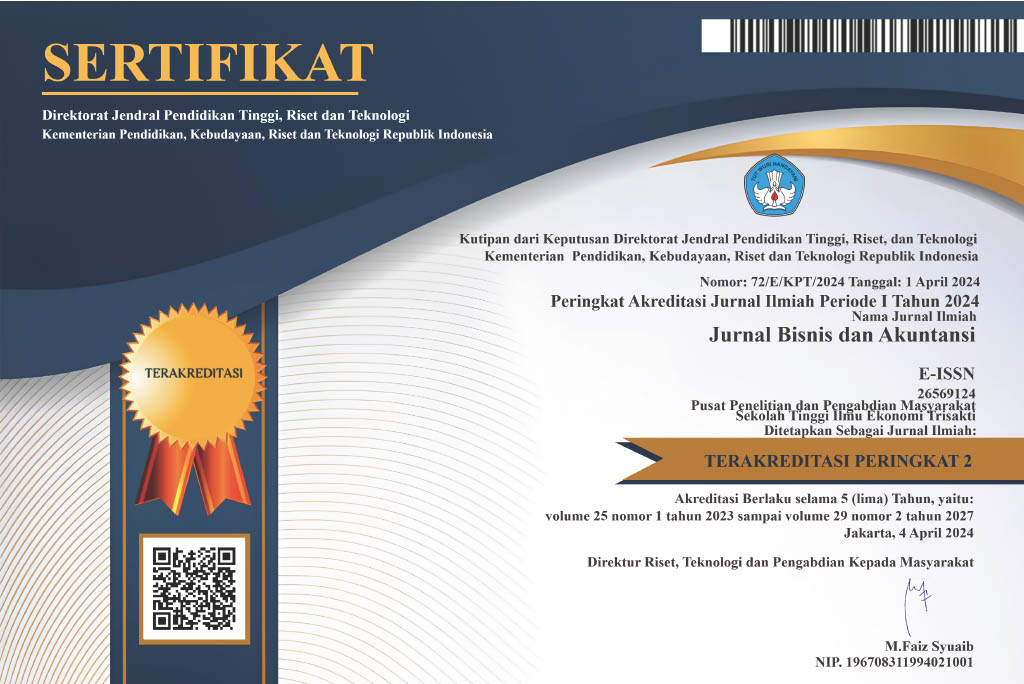
Correction and Retraction
1. Policy Statement
Jurnal Bisnis dan Akuntansi (JBA) is committed to maintaining the accuracy, credibility, transparency, and integrity of the scholarly record. The journal recognizes that errors, inaccuracies, or ethical concerns may be discovered after an article has been published and that appropriate editorial action may be necessary to protect the reliability of published research.
This Correction and Retraction Policy establishes the procedures for addressing errors and concerns identified in articles published by JBA. All decisions will be made carefully, fairly, and transparently, taking into consideration the nature and severity of the issue and its implications for the validity of the published work.
JBA follows the principles of responsible scholarly publishing and takes into account the relevant guidelines and recommendations of the Committee on Publication Ethics (COPE).
The primary objective of this policy is to preserve the integrity of the academic record and ensure that readers are informed of significant corrections or changes to published articles.
2. Scope of the Policy
This policy applies to all articles published in JBA, including research articles and other scholarly contributions accepted for publication by the journal.
Issues covered by this policy include, but are not limited to:
-
Errors in data, statistical analyses, calculations, tables, figures, or references.
-
Errors in the interpretation or presentation of research findings.
-
Methodological errors that affect the validity or reliability of research conclusions.
-
Plagiarism or substantial overlap with previously published material.
-
Data fabrication, data falsification, or manipulation of research findings.
-
Duplicate or redundant publication without appropriate disclosure.
-
Authorship irregularities or undisclosed conflicts of interest.
-
Violations of research ethics or publication ethics.
-
Other circumstances that may compromise the reliability or integrity of a published article.
The Editor-in-Chief and Editorial Board will evaluate each case individually and determine the appropriate action based on the available evidence.
3. Corrections
JBA may publish a formal correction when an error is identified in a published article but the error does not invalidate the overall findings or principal conclusions of the research.
Corrections may be necessary for errors involving numerical data, statistical results, tables, figures, author names, affiliations, references, or other information that requires amendment to ensure the accuracy of the published record.
A correction may be requested by the authors, identified by the editorial team, or reported by readers, reviewers, or other interested parties.
Upon receiving a report of a possible error, the editorial team will assess its significance and determine whether a formal correction is necessary. Authors may be asked to provide supporting documentation or a corrected version of the relevant information.
When a formal correction is approved, JBA will:
-
Publish a correction notice that is clearly identified as such.
-
Identify the original article by its title, authors, publication details, and DOI, where available.
-
Describe the error and provide the corrected information.
-
Establish a direct link between the correction notice and the original article.
-
Maintain an accessible and transparent record of the correction.
Minor typographical or formatting errors that do not affect the interpretation or reliability of the research may be corrected without a separate correction notice, provided that the changes do not materially alter the published content and are handled transparently.
4. Retractions
JBA may retract a published article when reliable evidence indicates that the article's findings, conclusions, or scholarly content are seriously compromised.
A retraction may be considered in circumstances including, but not limited to:
-
The findings are unreliable because of major methodological errors, substantial miscalculations, data fabrication, or data falsification.
-
The article contains substantial plagiarism or unauthorized use of previously published material.
-
The article constitutes duplicate or redundant publication that materially violates publication ethics.
-
Serious research misconduct or ethical violations have affected the integrity of the publication.
-
The peer-review process was manipulated or the publication was obtained through fraudulent practices.
-
Undisclosed conflicts of interest or other serious irregularities materially undermine the credibility of the article.
-
Other circumstances establish that the published work cannot be relied upon.
The decision to retract an article will be based on the available evidence and the seriousness of the identified concerns.
The Editor-in-Chief is responsible for the final editorial decision, with input from the Editorial Board, independent experts, or relevant institutions when appropriate.
A retraction may be issued even if the authors do not agree with the decision, provided that sufficient evidence supports the action. Authors will be given a reasonable opportunity to respond to the concerns before a decision is finalized, where practicable.
5. Retraction Procedure
JBA will follow a fair and systematic procedure when considering a possible retraction.
5.1. Identification of Concerns
Concerns may be raised by authors, readers, reviewers, editors, academic institutions, or other parties with relevant information.
Reports should identify the article concerned and provide a clear explanation of the suspected error, misconduct, or ethical issue, together with supporting evidence where available.
5.2. Preliminary Assessment
The editorial team will conduct an initial assessment to determine whether the reported concerns warrant further investigation.
The Editor-in-Chief may request additional information, original data, supporting documents, explanations from the authors, or advice from qualified experts.
5.3. Communication with Authors
The corresponding author and, where appropriate, the co-authors will be informed of the concerns and given a reasonable opportunity to provide explanations and relevant evidence.
The journal will consider the authors' responses fairly and objectively.
5.4. Investigation and Evaluation
The Editorial Board will evaluate the available information and may consult independent specialists, the authors' institutions, or other relevant authorities when necessary.
Investigations will be conducted impartially, with due consideration for confidentiality, procedural fairness, and the protection of the scholarly record.
5.5. Editorial Decision
Following the assessment, the Editor-in-Chief may decide to:
-
Take no further action if the concerns are not substantiated.
-
Publish a correction if the issue can be resolved without invalidating the principal findings.
-
Publish an Expression of Concern if significant concerns remain unresolved while further information is sought.
-
Retract the article if the evidence justifies retraction.
The selected action will be proportionate to the nature and severity of the issue.
5.6. Publication of the Retraction Notice
When retraction is warranted, JBA will publish a formal retraction notice explaining the reasons for the decision and identifying the affected article.
The notice will be made publicly accessible and linked to the original article to ensure that readers can readily identify the article's publication status.
6. Retraction Notice and Article Status
A retraction notice issued by JBA should include, where applicable:
-
The title and bibliographic details of the affected article.
-
The names of the authors and the DOI, if available.
-
A clear statement that the article has been retracted.
-
The reasons for the retraction and a description of the basis for the decision.
-
The date of publication of the retraction notice.
-
The party initiating or issuing the retraction, where appropriate.
The original article will generally remain available in the journal's online archive to preserve the scholarly record. Where technically feasible, the article will be clearly marked as RETRACTED and linked to the corresponding retraction notice.
JBA will update the article's metadata and notify relevant indexing or registration services where appropriate and technically supported.
7. Expression of Concern
JBA may publish an Expression of Concern when credible questions arise regarding the integrity or reliability of a published article, but the available evidence is insufficient to justify an immediate correction or retraction.
An Expression of Concern may be appropriate when:
-
Credible evidence suggests possible research misconduct, but the matter has not been conclusively established.
-
An investigation by the journal or a relevant institution is ongoing.
-
A relevant institution is unable or unwilling to investigate a serious allegation.
-
Significant concerns remain unresolved despite reasonable efforts to obtain clarification.
The notice will identify the affected article and explain the nature of the concerns without presenting unverified allegations as established facts.
JBA may update or supplement the notice when additional evidence becomes available and a further editorial decision is justified.
8. Article Removal
JBA generally seeks to preserve published articles as part of the permanent scholarly record, including articles that have been retracted.
Removal of an article from public access will be considered only in exceptional circumstances, such as serious legal violations, breaches of privacy, defamatory content, or other substantial risks that cannot be adequately addressed through a correction or retraction notice.
Where removal is necessary, JBA will preserve an appropriate bibliographic record and provide an explanation of the action where legally permissible.
Such decisions will be made by the journal in consultation with the publisher and relevant authorities when appropriate.
9. Responsibilities of Authors
Authors are responsible for the accuracy, originality, and integrity of their published work.
If authors discover a significant error or inaccuracy in an article they have published in JBA, they should promptly notify the editorial office and provide relevant information and supporting evidence.
Authors are expected to cooperate with the journal's assessment and investigation procedures, respond to reasonable requests for clarification, and assist in preparing corrections when appropriate.
An author's failure to respond or cooperate will not prevent JBA from taking appropriate editorial action when sufficient evidence supports such action.
10. Editorial Responsibilities
The Editor-in-Chief and Editorial Board are responsible for ensuring that post-publication concerns are assessed appropriately and that decisions are made in accordance with publication ethics principles.
In handling correction and retraction cases, the editorial team will:
-
Assess reported concerns objectively and without discrimination.
-
Evaluate the available evidence before reaching a decision.
-
Provide affected authors with a reasonable opportunity to respond.
-
Maintain confidentiality where appropriate.
-
Avoid or manage conflicts of interest in the investigation and decision-making process.
-
Seek independent expert advice when necessary.
-
Communicate editorial decisions and their rationale appropriately.
-
Ensure that corrections, Expressions of Concern, and retraction notices are clearly linked to the relevant articles.
If an editor has a conflict of interest involving an article under investigation, the matter should be assigned to an independent editor or another qualified editorial representative.
11. Appeals and Complaints
Authors or other parties directly concerned with a correction or retraction decision may submit an appeal to the JBA editorial office.
An appeal should include a clear explanation of the grounds for disagreement and any additional evidence relevant to the decision.
The Editor-in-Chief, or an independent editorial representative where a conflict of interest exists, will review the appeal and may seek independent expert advice when necessary.
The journal will consider new evidence and may revise its decision when justified. An appeal will not automatically suspend an editorial action necessary to protect the integrity of the scholarly record.
12. Transparency and Preservation of the Scholarly Record
JBA is committed to maintaining a transparent and reliable record of its published research.
Corrections, Expressions of Concern, and retraction notices will be made publicly accessible as appropriate and linked to the relevant original articles.
The journal will not make substantive changes to published findings or conclusions without appropriate disclosure. Any post-publication action will be documented in a manner that enables readers to understand the status of the article and the nature of the action taken.
Where applicable, associated metadata will be updated to reflect the article's current status.
13. Compliance with Publication Ethics
This policy should be read in conjunction with JBA's Publication Ethics Policy, Editorial Policy, and other relevant journal policies.
JBA considers the applicable principles and recommendations of the Committee on Publication Ethics (COPE) when evaluating post-publication concerns and determining appropriate editorial action.
The journal may review and update this policy as necessary to maintain consistency with developments in publication ethics and responsible scholarly publishing.
14. Reporting Errors and Ethical Concerns
Authors, readers, reviewers, and other stakeholders who identify potential errors or ethical concerns in articles published by JBA are encouraged to contact the editorial office.
Reports should include the article title, DOI or URL where available, a clear description of the concern, and supporting evidence where applicable.
Editorial Contact
Jurnal Bisnis dan Akuntansi (JBA)
Sekolah Tinggi Ilmu Ekonomi Trisakti
Jakarta, Indonesia
Website: https://www.jurnaltsm.id/index.php/JBA/index
Email: jba@stietrisakti.ac.id
JBA will review reports responsibly and take appropriate action to maintain the accuracy, credibility, and integrity of the scholarly record.







 ISSN Online (E-ISSN
 .